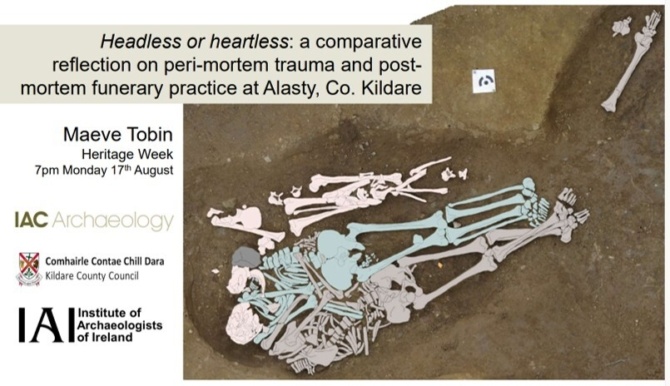
Headless of Heartless: a comparative reflection on peri-mortem trauma and post-mortem funerary practice at Alasty, Co. Kildare
Join the Institute of Archaeologists of Ireland, IAC Archaeology and Kildare County Council for our free online Heritage Week Lecture with archaeologist Maeve Tobin, as she details findings from two burials from Alasty, Co. Kildare.
Death by decapitation, whether carried out in fever pitch or measured deliberation, has always had an unparalleled finality. Separation and permanent loss of the head, considered to be the intellectual, emotional, spiritual core of a person, was employed to achieve an eternal impact on the dead and the living. The post-mortem treatment of decapitated individuals can equally reflect nuanced social choices. A revealing comparison of two such scenarios was recently recorded at Alasty, Co. Kildare. Excavation here exposed a narrow glimpse of a previously unknown burial ground established in the 6–7th century AD, with evidence for considerable longevity.
Despite the passage of almost 600 years and significant societal and political changes this burial ground was twice chosen for the internment of men whose final violent fate included losing their heads to the sword. The burials occurred during particularly politically dynamic times, fraught with intercommunity violence, within long contested spaces. This paper reviews the archaeological record at Alasty, the 'lighted ford' to explore possible narratives for the events leading up to and after the death of these men.
Foghlaim níos mó faoin eagraitheoir
Cineál Imeachta
Deontas Comhairle Oidhreachta
Tá an imeacht seo mar chuid de tionscadal a bhfuil maoiniú faighte aige ó Scéim Deontais na gComhairle Oidhreachta i 2026.
